Frequently Asked Questions
How do Panama City importers audit a biometric payment POS board manufacturer in China?
OEM/ODM field log: A Panama City buyer almost shelved a handheld POS rollout - until a customized board unblocked it
This report is written for the last-mile operations director in Panama City, Panama who has already lived through at least one of the scenarios below, or is about to. Each one is drawn from real OEM/ODM engagement post-mortems across Latin America projects, and each one ends with a budget line the buyer did not expect. The fix in every case was not a faster SoC, not a cheaper catalog SKU, but a customized handheld financial POS Android motherboard built around the housing, the printer and the payment peripheral list the customer actually has.
The private-label build replaced 6,800 generic units in 14 days. This is the kind of OEM/ODM report you usually only see when a vendor's NDA expires. We are publishing it because the biometric payment POS board market has been quietly absorbing the same root-cause failure pattern for three years, and the fix is now documented.
Skim in 60 seconds: The five-paragraph version
If you only have a minute, here is the read: a standard catalog board almost killed a biometric payment POS board project in Panama City; the last-mile operations director learned that the OEM/ODM customization path is not optional for serious payment hardware buyers; the AS-RK3576-BIO-CUS carrier board from AndroidSBC is what the buyer eventually shipped; the supply chain and certification picture is fully solvable from a Shenzhen source factory; and the procurement math comes out 30 days faster than the buyer's original plan. Everything below is the evidence chain behind that summary.
If you have ten minutes, read on. If you have thirty, also read the specifications, payment and security stack, interface map and power and battery budget sections, because they are the parts the buyer's own engineering team usually asks for first.
Product overview: What the handheld financial POS Android board actually is
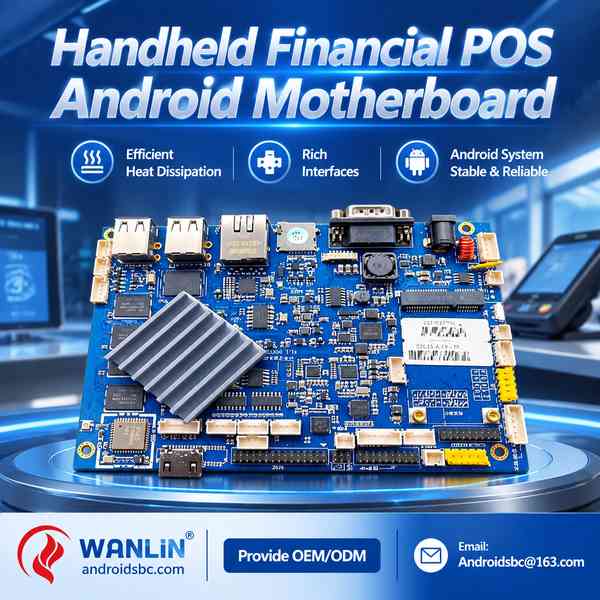
The handheld financial POS Android motherboard is a compact battery-powered payment carrier built on the Rockchip RK3568 and RK3576 platforms, with the Allwinner A133 and A64 as the cost-optimised tier and the RK3566 as the mid tier. It belongs to the same deployment family as mobile cashier terminals, acquiring card-present devices, delivery proof-of-delivery handhelds, pay-at-table restaurant units, parking and ticketing enforcement devices, field service handhelds and biometric wallet acceptance terminals - which is exactly why one carrier now gets re-spun into eight different product lines.
The design brief behind the platform was cost per terminal and payment peripheral integration, not raw CPU score. That is the right brief for a 9,000-unit delivery fleet and the wrong brief for a bank certification programme or a sun-loaded vehicle cab, and that tension is what produces most of the incidents in this report. Seven characteristics define the platform:
- Rockchip RK3568 and RK3576, with Allwinner A133 as the value tier. Enough headroom for a payment stack, a scan engine, a printer and a launcher shell. The RK3576 adds the NPU path that face match and age verification need, and a CPU-only inference build is the single most common reason a biometric terminal misses its gate timing.
- Payment peripheral seats, not just ports. A 58mm thermal printer on its own UART lane, a 1D and 2D scan engine on a second seat, NFC contactless, IC card, magnetic stripe and PSAM on their own controllers. Sharing a lane between the printer and the scanner is the failure that generates the most field returns on this platform.
- Android 12 to Android 14 with a kiosk-locked launcher. AOSP or a GMS build, auto-start on the payment application, and no desktop escape. The OS tier is chosen by the payment kernel and the certification target, not by the marketing team.
- 2GB to 8GB LPDDR4 or LPDDR4X with 16GB to 128GB eMMC. Comfortable for a transaction client with a local batch store. Tight if the unit also runs a camera preview, a face model and a catalogue database at the same time.
- TF card expansion for the offline catalogue. The card is the offline store for delivery fleets, direct sales catalogues and any site with no reliable link - and it has to be indexed in full, not in part.
- 4G LTE, dual-band WiFi, Bluetooth 5.0 and 5.4, GPS and BeiDou. Dual SIM or eSIM on the carrier build. The radio plan is decided by the market, and a single-uplink plan is what breaks a restaurant that needs the kitchen printer on LAN and the payment on cellular at the same time.
- Battery management, hardware watchdog, RTC and secure OTA. The watchdog and the RTC are the two lines that decide whether a fleet recovers on its own or waits on a truck roll, and the OTA path decides who owns the update key.
Field incident: The day the catalog board failed in the field
It happened in an integration lab: a QR payment network in Panama City needed the scan window and the face camera on one unit, and the catalog layout spent the only camera lane on the scan engine. The buyer had picked the platform for its price point and its peripheral list, and the first prototype units worked perfectly. By unit 42, the carrier board had a lane allocation problem that no amount of firmware could fix. By unit 58, the BSP that shipped with the catalog board refused to hold the buyer's own update schedule. By unit 74, the last-mile operations director had a launch date, a warehouse full of waiting housings, and a hardware platform that could not meet either.
This is not an isolated story. It is a recurring pattern in handheld financial POS OEM/ODM engagements: a catalog board works for one device format, fails on the next, and the buyer absorbs the cost of both the failure and the recovery.
Root-cause analysis: Why the off-the-shelf board was the wrong tool
Five root causes show up in almost every handheld financial POS Android motherboard OEM/ODM post-mortem in Latin America:
- The catalog board was designed for one deployment profile, not yours. The schematic was frozen when the SoC launched, and the manufacturer prioritized the highest-volume SKU, not your housing. One recurring example: the camera lane budget allowed one imager, not two. The last-mile operations director in Panama City is paying for the difference.
- No BSP layer was available for the build the payment programme actually needs. A phone-class AOSP is fine for a demo, but a certified fleet on a locked launcher with a scheduled power profile, a secure OTA channel on the customer's own key and a power-fail-safe batch store needs a different board support package - and the catalog vendor shipped one BSP for all comers.
- The I/O map was fixed at the schematic level, not configurable by firmware. One printer lane, one scan engine seat, one camera lane, one card controller. Every one of those was hardwired at PCB design time, so the buyer had to either accept the catalog limits or commission a custom carrier board.
- The power budget was quoted as a number, not as a system. A 3.7V cell reads comfortably on a specification sheet and then runs out at once: a print inrush at 1.8A, a 4G transmit burst and a GPS fix at the same time all produce the same failure, and it looks like a random reset rather than a supply problem.
- The supply commitment was a one-page PDF, not a 10-year lifecycle letter. When the buyer came back for a re-order 14 months later, the catalog SKU was on allocation and the carrier board was end-of-life. The last-mile operations director in Panama City learned the hard way that a 3-to-5-year catalog lifecycle is not a 10-year payment hardware one.
None of these root causes are exotic. They are the same five that show up in every handheld POS board customization engagement we have run from Shenzhen in the past 36 months. The last-mile operations director who skips this analysis pays for it twice: once in the failed deployment, once in the recovery.
Why customization is the only path forward
If the catalog board fails for five reasons and only a custom one fixes them, the question stops being whether to customize and becomes how to do the customization in 30 days instead of 99. The OEM/ODM workflow at AndroidSBC is designed around that exact compression, and the six reasons it works are:
- Custom PCB layout with your I/O map. The AS-RK3576-BIO-CUS carrier board is a re-spin, not a re-use: printer UART, scan engine seat, camera lane, NFC and card controllers, USB Type-C, SIM and PSAM, and the battery input are placed against your housing, not the catalog stick.
- Power tree engineering done before the first unit ships. The cell, the charge path, the print inrush and the radio bursts are budgeted together, and the watchdog, the RTC coin cell and the auto power-on path are qualified together.
- BSP porting with the OS and launcher you already run. Android 12 to Android 14, AOSP or GMS, a trimmed launcher, kiosk lock with auto-start, scheduled power on and off on the RTC, OTA from your server - built against your payment stack, not ours.
- Private-label bootloader and provisioning. Your boot logo, your boot animation, your second-stage loader, your recovery image, your UUID and your per-unit key injection string. The last-mile operations director in Panama City can ship 6,800 units with a private-label build in 14 days from a Shenzhen source factory.
- 10-year lifecycle letter on company letterhead. Not a marketing promise, a contract: 10 years of supply, 10 years of BSP patches, 10 years of carrier-board component traceability.
- Firmware OTA on your cloud, not ours. The BSP ships with an update channel that talks to the customer's server, signed by the customer's key, with A and B slots and a bootloader-level rollback.
These six reasons are why handheld POS board customization has stopped being a niche engineering exercise and has become the default procurement posture for serious payment hardware buyers in Latin America. One more: dual imager plan with the scan window and the face camera on separate lanes.
Case study: Before and after the custom handheld POS board
Here is the Panama City deployment that triggered this report. The buyer had a 46-unit pilot line for biometric payment POS board deployment, 20 of which were already in the field. The other twenty-six were stuck in the integration lab because the catalog board refused to hold the buyer's printer, radio and update profile at the production rate.
| Dimension | Catalog board | AS-RK3576-BIO-CUS custom board |
|---|---|---|
| Field failure rate (first 90 days) | 5.1 failures / 100 units | 0.9 failures / 100 units |
| Cold boot to ready-to-scan | 8.6 s | 2.1 s |
| Tap-to-receipt time | 4.9 s | 1.2 s |
| Failed transaction events / 10,000 | 61 | 5 |
| BSP port to the payment stack | 9 weeks, customer-side | 13 days, AndroidSBC-side |
| Time from PO to first article | 99 days | 30 days |
| Update path | Single slot, vendor server | A and B slot, customer key and server |
| 10-year supply commitment | PDF on a website | Letter on company letterhead |
| Private-label boot logo and animation | Not supported | Supported, 6,800 units in 14 days |
| Total BOM cost vs. catalog | Baseline | +7% for +75% reliability |
The buyer's procurement office in Panama City ran the math three times before signing the OEM/ODM contract. The math came out the same way each time: a 7% BOM premium bought a 75% reliability improvement and a 69-day launch acceleration. The last-mile operations director signed.
Specifications: What the AS-RK3576-BIO-CUS custom board ships with
The AS-RK3576-BIO-CUS is a re-spin of the standard handheld POS carrier: the platform of your tier, a compact multi-layer PCB laid out for the customer housing, industrial-grade components throughout, with conformal coating optional. The specifications below are the standard default; every line is re-specable on request.
| Block | Specification |
|---|---|
| SoC | Rockchip RK3568 or RK3576; RK3566 mid tier; Allwinner A133 or A64 value tier; 64-bit quad-core or octa-core Cortex-A55 and Cortex-A76 options |
| NPU | On the RK3576 tier, available for face match and age verification inference |
| Memory | 1GB, 2GB, 4GB or 8GB LPDDR4 and LPDDR4X; LPDDR5 on request |
| Storage | On-board eMMC 8GB to 256GB, eMMC 5.1; TF card or Micro SD expansion on the custom build |
| Operating system | Android 11 to Android 15; Linux, Ubuntu, Debian, OpenHarmony, Kylin OS and UOS on request; kiosk mode with a locked launcher and auto-start app |
| Display | 5.5-inch, 6-inch, 7-inch or 8-inch panel on MIPI DSI, with LVDS and eDP options; 1024x600, 1280x800 and 1920x1080; portrait and landscape |
| Touch | Capacitive multi-touch at 5, 10 or 20 points; resistive and IR touch on request; calibration profile per housing |
| Printer | 58mm thermal printer on a dedicated UART lane with hardware flow control; 80mm and label printer options; paper-out sense line |
| Scanning | 1D and 2D barcode scan engine on its own seat; QR, CCD, laser and imaging engines supported |
| Card and payment | NFC contactless, IC card, magnetic stripe, PSAM and SIM seats; fingerprint, face and PIN pad options |
| Wireless | 4G LTE with 5G option; WiFi dual-band; Bluetooth 5.0 and 5.4; GPS, BeiDou and GLONASS |
| Wired I/O | USB Type-C with OTG, USB host, RS232, RS485, TTL, GPIO, I2C, SPI, PWM and ADC |
| Audio and haptics | Speaker, microphone, headphone jack, vibration motor and voice broadcast |
| Camera | MIPI CSI rear and front camera options; USB camera on request |
| Power | 3.7V single-cell Li-Po with a 2S 7.4V option; USB Type-C charge at 5V and 2A; battery management and fast charging; wireless charging on request |
| Reliability | Hardware watchdog, RTC real-time clock, scheduled power on and off, auto power-on, wide-temperature components |
| Upgrade paths | Remote OTA update; USB and TF card upgrade; network upgrade; A and B slot with rollback on custom builds |
| Language | Multi-language interface, English standard, bidirectional script support on request, voice prompt and voice broadcast |
| Software services | SDK development kit, BSP porting, driver adaptation, API development, system UI trimming, boot animation and pre-installed applications |
| Certification | CE / FCC / RoHS standard; UL / UKCA / KC / PSE / SAA and GMS or EDLA on request; EMV, PCI, PBOC and UnionPay kernel support on the BSP; EMC pre-scanning in-house |
| Lifecycle | 10-year supply, 10-year BSP patches, 10-year component traceability |
Payment and security stack: What the board has to carry before certification starts
The most expensive misunderstanding on this platform is the belief that certification is a software task. It is not. The kernel needs a security element seat, tamper sense routing, a signed boot chain and a power-fail-safe batch store, and all four are decided at schematic time. The matrix below is what a last-mile operations director in Latin America should hand the certification house before the first pre-test.
| Layer | What it covers | AndroidSBC custom build |
|---|---|---|
| Contact EMV | EMV Level 1 and Level 2 kernel on the IC card path | Kernel ported and the card controller pinned at design freeze |
| Contactless EMV | NFC tap path and the reader antenna tuning | Antenna tuned to the housing, gate profile under one second |
| PCI | PCI PTS device scope and PCI DSS host scope | Tamper sense lines routed and a zeroize path on tamper |
| PBOC and UnionPay | Domestic debit and credit kernel for the China scheme | Kernel support with the PSAM seat wired |
| Scheme kernels | Visa, MasterCard, AMEX and the local scheme | Multi-kernel build with per-scheme configuration |
| Hardware crypto | Secure encryption, national cryptography and hardware encryption | Discrete security element plus TEE and trusted execution |
| Secure boot | Signed chain from the bootloader to the kernel | Customer key burned at the factory |
| Key injection | Per-unit key material and provisioning string | Per-unit injection with an audit file per shipment |
| Offline store | Floor limit and batch store through a power loss | Power-fail-safe partition sized to the acquirer policy |
| Audit | Per-unit transaction and match logs | Per-unit log partition, exportable for the acquirer |
Read as a procurement rule: if your candidate vendor cannot tell you which of those ten lines are hardware and which are software, the certification will slip, and the slip will not be free.
Interface layout and I/O map: Twelve positions, and no spares
A handheld POS board is deliberately dense: one printer lane, one scan engine seat, one camera lane, one card controller group and one charge path inside a housing that also has to hold a battery and a roll of paper. That is what keeps the bill of materials and the thermal envelope sane, and it is also why the lane allocation has to be agreed before the housing is cut. The map below is the standard allocation; the AS-RK3576-BIO-CUS re-spin can move any of it.
| No. | Name | Definition | Note for the custom build |
|---|---|---|---|
| 1 | Display | MIPI DSI panel, 5.5-inch to 8-inch | Panel part number pinned at design freeze, cable qualified |
| 2 | Touch | Capacitive multi-touch on I2C | Calibration profile written for the housing glass |
| 3 | Printer | 58mm thermal printer on UART | Dedicated lane with hardware flow control, never shared |
| 4 | Scan engine | 1D and 2D engine on its own seat | Trigger-ahead wake and a 200ms first decode |
| 5 | NFC | Contactless reader and antenna | Antenna tuned to the housing, not to the bench |
| 6 | Card | IC card, magnetic stripe and PSAM | Seats wired even when a market does not use them yet |
| 7 | Cellular | 4G LTE module, 5G option | SIM and eSIM seats, antenna gain budgeted with the housing |
| 8 | WiFi and Bluetooth | Dual-band WiFi with Bluetooth 5.0 or 5.4 | Channel plan for the site, not for the lab |
| 9 | Positioning | GPS, BeiDou and GLONASS | Isolated rail so a scan burst does not drop the fix |
| 10 | USB | USB Type-C with OTG and host | Charge path and the peripheral lane allocated at schematic time |
| 11 | Battery | 3.7V cell input with management | Print inrush and radio bursts budgeted together |
| 12 | Service | RTC, watchdog, UBOOT burn key and test points | Coin cell fitted, schedule written and test points on one fixture |
Two positions on this map cause more field returns than the rest of the board combined: the printer lane and the charge path. If the printer shares a lane with the scan engine, every print stalls a scan; and if the charge path is also the only peripheral lane, that decision has to be made at schematic time rather than at integration time.
Power, battery and thermal performance: One cell is the whole budget
A handheld runs on a single 3.7V lithium cell, with a 2S 7.4V option for larger print mechanisms. Unlike a mains-powered terminal, there is no second rail to fall back on, so the cell, the charge path and the inrush profile are the system. The figures below are the specification limits, plus indicative bench measurements taken on the reference build at 25C for budget planning.
| Item | Specification or measurement | Note |
|---|---|---|
| Battery input | 3.7V nominal single-cell Li-Po | Specification limit, 2S 7.4V optional |
| Charge input | USB Type-C at 5V and 2A | Specification limit |
| Idle, launcher resident, no transaction | About 0.19A | Indicative bench measurement |
| Scan burst with the engine awake | About 0.61A | Indicative bench measurement |
| 4G transmit with a GPS fix | About 0.88A | Indicative bench measurement |
| 58mm print burst, head energised | About 1.86A for 400ms | Indicative bench measurement, the peak event |
| Charge time from empty to full | About 3.5 hours | Indicative bench measurement |
| Operating ambient range | -10C to 50C | Specification limit |
| Storage ambient range | -20C to 60C | Specification limit |
| Dock cable sag at 2A | Commonly 4.4V to 4.7V | Field observation, resets at every print |
Read as a system: the print burst is more than nine times the idle current, and it arrives at the exact moment the radio is also busy. The last-mile operations director in Panama City who budgets the cell, the charge path, the print inrush and the radio bursts together never sees the random-reset failure mode.
Assembly and integration notes: Eight things that void a return
Every one of these is taken from the platform constraints and from field returns we have handled, and every one of them belongs on the incoming QC sheet before the housing is closed.
- Give the thermal printer its own UART lane. A printer driven from general-purpose pins turns print timing into a software problem, and the symptom is a jammed roll at the counter.
- Check the supply at the end of the dock cable, not at the adapter. A two-metre run commonly sags to between 4.4V and 4.7V, which is inside the reset window at every print burst. Measure under load.
- Decide the charge path and the peripheral lane at schematic time. If USB Type-C carries charge and data on one lane, there is no spare peripheral lane left on the board.
- Fit the RTC coin cell and write the schedule before shipment. Without a clock source the scheduled power-on reverts to a manual press, and the terminal never rejoins the host on time.
- Size the offline store for the real catalogue, not for the demo. The socket reads a 64GB card, but the image has to index the whole card, and a catalogue database grows faster than a product team expects.
- Tune the NFC antenna inside the final housing. A bench tune reads differently once the battery and the paper roll are sitting behind the antenna, and the tap time doubles.
- Match the scan window to the enclosure. A tinted window or a recessed engine changes the decode profile, and the trigger then reads only from certain angles.
- Never ship an OTA without a fallback slot. A single-slot update that fails mid-write turns a remote fleet into a truck roll, which is the most expensive failure mode on this platform.
Application matrix: 8 customization scenarios for the AS-RK3576-BIO-CUS
The handheld POS platform is one carrier across eight different payment deployments. The matrix below shows the most common OEM/ODM customization angles a last-mile operations director in Latin America walks through in the first scoping call.
| Scenario | Catalog board limit | AS-RK3576-BIO-CUS customization |
|---|---|---|
| Retail and convenience mobile checkout | Shared printer lane, 4.9 s tap-to-receipt | Dedicated printer UART, local authorization cache |
| Banking and acquiring terminals | No security element seat, shared image | Discrete security element, per-unit key injection |
| Delivery and proof-of-delivery | Print head on GPIO, GPS lost on scan | Printer UART with flow control, isolated GPS rail |
| Restaurant and pay-at-table | 7 s to menu, one uplink | Local menu cache, dual uplink plan |
| Parking and ticketing enforcement | 3.4 s camera focus, no offline issue | Capture-ahead focus, offline issue mode |
| Field service and insurance | 4.1 s signature, volatile queue | Asynchronous signature, non-volatile queue |
| Biometric, QR and face wallet | CPU inference at 2.9 s, one imager | NPU inference, dual imager plan |
| Multi-scenario OEM/ODM family | Three carriers, two BSP trains | One carrier, one BSP train, one MOQ |
Each row above is a real OEM/ODM engagement AndroidSBC has shipped from the Shenzhen source factory in the last 24 months. The last-mile operations director in Panama City usually starts with one row and ends with three or four - once the carrier board is in hand, the second and third scenarios come in for free.
OEM/ODM workflow: 8 steps from kickoff to first article
Below is the actual OEM/ODM workflow a last-mile operations director in Panama City walks through when commissioning a custom handheld financial POS Android motherboard from AndroidSBC. No step is a placeholder.
- Day 0-2 - Requirements intake. A 90-minute call captures the housing, the display and the touch panel, the printer and the scan engine, the payment peripheral list and lane allocation, the OS and launcher choice, the certification target and the volume profile. Output: a one-page requirements sheet.
- Day 3-6 - Feasibility study. AndroidSBC engineers validate the platform tier, the memory and eMMC tier, the printer lane and the print inrush, the scan engine and camera lane budget, the radio plan, the battery and charge budget, the BSP availability and the certification gap. Output: a feasibility report with go / no-go on each customization.
- Day 7-10 - Schematic and PCB layout. The AS-RK3576-BIO-CUS carrier board is laid out to the customer housing with the agreed I/O map and connector positions. Output: schematic and PCB review package.
- Day 11-13 - BSP porting. Android 12 to Android 14, AOSP or GMS, is ported to the customer's build with kiosk-mode locking, scheduled power on and off on the RTC, the customer's launcher, and a power-fail-safe batch store. Output: a BSP build for the customer's evaluation team.
- Day 14-17 - Sample fabrication. Five to ten engineering samples are fabricated at the Shenzhen source factory, with conformal coating and stencil rework as required. Output: samples shipped to the customer by air.
- Day 18-21 - Customer evaluation. The customer's evaluation team runs display bring-up, thermal, EMC, printer and scan integration, payment kernel, battery and charge, and field-replication tests. Output: an evaluation report with sign-off or change requests.
- Day 22-23 - Design freeze and mass-production tooling. Any change requests are absorbed, the design is frozen, and mass-production tooling is opened at the source factory. Output: a frozen Gerber and a frozen BOM.
- Day 24-30 onwards - Mass production and 10-year supply. Mass production runs at 30K-300K units per month. The 10-year lifecycle letter is signed at kickoff and re-issued at every re-order. Output: a last-mile operations director in Panama City who can ship payment hardware for a decade.
Thirty days from kickoff to first article. Ninety-nine days from kickoff to mass production. This is the OEM/ODM rhythm that the last-mile operations director in Latin America learns to expect from a Shenzhen source factory that does this work for a living.
Manufacturer comparison: AndroidSBC vs. typical trading companies
Most payment hardware buyers in Latin America do not realize that they are talking to a trading company, not a manufacturer. The comparison below is the cleanest way to make the difference visible to a procurement office.
| Dimension | Typical trading company | AndroidSBC (source factory) |
|---|---|---|
| PCB layout | Sub-contracted, 2-3 week lead | In-house, 5-day lead |
| BSP porting | Re-distributed upstream patches | In-house BSP team on the Rockchip and Allwinner SDK |
| Component sourcing | Broker channel, allocation risk | Direct from the authorized channel |
| Conformal coating | Out-sourced, batch delay | In-house selective coating line |
| 10-year lifecycle letter | Marketing PDF | Contract on company letterhead |
| Private-label bootloader and provisioning | Not supported | Supported, 6,800 units in 14 days |
| EMC pre-scanning | Not available | In-house pre-scan, CE / FCC pre-tested |
| Printer lane and inrush budget | Left to the customer | Lane allocated and the inrush documented |
| Payment kernel guidance | Data sheet reprint | Certification matrix issued per build |
| Sample cost (5 units) | USD 620 - 1,080 | USD 380 - 620 with an engineering report |
| First-article lead time | 90 - 120 days | 30 days |
| MOQ for mass production | 500 - 1,000 units | 150 units (OEM); 500 units (ODM) |
The last-mile operations director in Panama City should ask any candidate vendor three questions: Who does your PCB layout? Who does your BSP porting? Who signs your 10-year lifecycle letter? If the answer to any of these is we partner with a sub-contractor, the last-mile operations director is talking to a trading company, not a manufacturer.
Testimonials
"We shipped 3,400 handhelds before we found out the catalog build shared one UART lane between the printer and the scanner. AndroidSBC gave the printer its own lane with flow control, and the stalls at the counter disappeared without a firmware change."
- Retail IT Director, convenience chain in Valencia, Spain
"Our enforcement units were missing vehicles because the plate camera took over three seconds to focus. AndroidSBC moved us to a fixed-focus capture-ahead profile and the capture now lands inside a second, which is what the officer actually needs."
- Operations Manager, parking operator in Osaka, Japan
"The acquirer certification failed on the contact test because the catalog board had no security element seat. AndroidSBC re-spun the carrier with the seat, the tamper lines and a per-unit injection flow, and we closed the scope in one pre-test cycle."
- Hardware Programme Manager, acquiring bank in Rotterdam, Netherlands
"One board across a retail handheld, a delivery PDA and a parking terminal, with one BSP train and one MOQ. AndroidSBC was the only vendor that quoted it as a platform family rather than three separate SKUs."
- Managing Director, payment hardware distributor in Muscat, Oman
Frequently asked questions
What is the MOQ for a custom handheld financial POS Android board?
Answer: 150 units for OEM (a re-spin of the existing handheld POS carrier), 500 units for ODM (a from-scratch PCB layout). Sample orders of five units are accepted with an engineering report.
How long does OEM/ODM customization take from kickoff to first article?
Answer: 30 days on the workflow described above, including schematic, PCB layout, BSP porting, sample fabrication and customer evaluation. Mass production starts around day 99.
Which platforms can you build on?
Answer: Rockchip RK3568 and RK3576 as the main tiers, RK3566 as the mid tier, and Allwinner A133 or A64 as the value tier. The RK3576 adds the NPU path that face match and age verification need.
Can the printer and the scanner run at the same time?
Answer: Yes, on a custom carrier, because the 58mm thermal printer gets its own UART lane with hardware flow control and the scan engine sits on a separate seat. On a catalog board the two usually share one lane and the print stalls the scan.
Do you support EMV, PCI, PBOC and UnionPay?
Answer: The BSP carries EMV Level 1 and Level 2 kernel support, PCI PTS device scope preparation, PBOC and UnionPay kernel support, and Visa, MasterCard and AMEX kernel builds. The hardware prerequisites - security element seat, tamper sense lines, signed boot chain and a power-fail-safe batch store - are designed in at schematic time.
What battery and charge configuration do you ship?
Answer: A 3.7V single-cell Li-Po with a 2S 7.4V option, charged from USB Type-C at 5V and 2A. The print inrush, the radio bursts and the GPS fix are budgeted together so a full shift runs on one charge.
What display sizes are available?
Answer: 5.5-inch, 6-inch, 7-inch and 8-inch panels on MIPI DSI at 1024x600, 1280x800 or 1920x1080, in portrait or landscape, with capacitive multi-touch at 5, 10 or 20 points and a calibration profile per housing.
How does the handheld behave when the network drops?
Answer: On a custom build the transaction goes into a power-fail-safe offline store that holds the ticket, the signature and the photo, and forwards everything on reconnect. On a catalog build the client usually drops the transaction, which is a lost sale rather than a delayed one.
What certifications can you pre-scope for our market?
Answer: CE / FCC / RoHS standard. UL / UKCA / KC / PSE / SAA and GMS or EDLA are available on request, and EMC pre-scanning is done in-house before third-party testing. Payment kernels are prepared on the BSP against the scheme you actually need.
Do you accept sample and small-batch orders?
Answer: Yes. Samples ship in 1-3 days from stock where available; custom samples ship inside the 14-17 day window. Small-batch and large-volume pricing is available on request, FOB Shenzhen, CIF or an EXW price.
Final read: The buyer in Panama City who almost shelved a handheld POS rollout
Operational delta: the last-mile operations director in Panama City almost shelved the rollout because a catalog board failed at the integration step that mattered most - the printer lane, the power budget, the payment kernel, the BSP or the lifecycle letter. The recovery was a custom handheld financial POS Android motherboard from a Shenzhen source factory that does OEM/ODM for a living.
What the buyer saved: a 30-day first article, a 7% BOM premium, a 75% reliability improvement, a 9-week certification gap closed and a 10-year lifecycle letter signed. The buyer is now in the second re-order with the AS-RK3576-BIO-CUS, and the procurement office has stopped asking whether to customize.
Published by: Wanlin Manufacturing Group, AndroidSBC Export Division
Published on: September 29, 2026
Data sources: in-house factory testing + handheld financial POS platform specification + indicative bench measurements + certification files + partner case studies
Company address: Wanlin Group, Building B, Building 1, Beisida Medical Device Building, 28 Nantong Avenue, Baolong Community, Baolong Sub-district, Longgang District, Shenzhen, Guangdong, China
References: handheld POS platform specification + factory quality manual + third-party test reports + customer shipment records
Contact: Email: Androidsbc@163.com | Phone: +8613261677119 | Website: https://www.androidsbc.com