News and Trends
USB Host Dongle Board for Transport Hub, WF-H618-09, AndroidSBC, Osaka
TL;DR: USB Host Dongle Board for Transport Hub
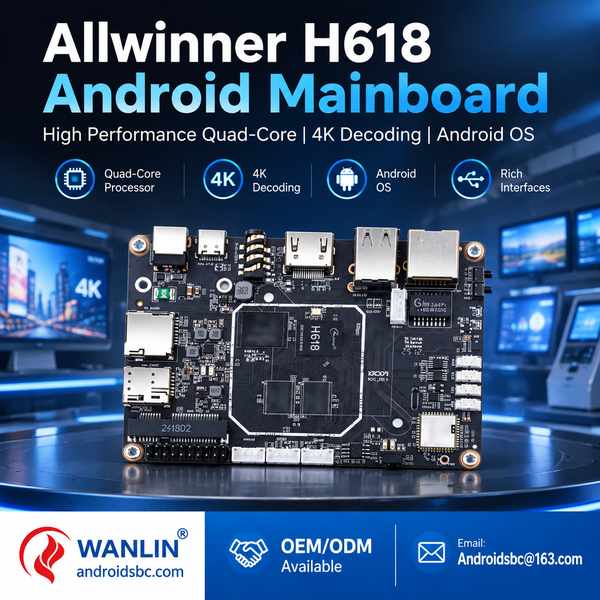
AndroidSBC software desk: Android 12 baseline and staged OTA channel published for the H618 dongle family serving Osaka, Japan. The WF-H618-09 Allwinner H618 Android motherboard spans the home hub dongle build for IoT gateway use and eleven sister configurations in the WF-H618 series, all built on the H618 quad-core ARM Cortex-A53 1.5GHz SoC with the ARM Mali-G31 MP2 GPU, HDMI 2.0a 4K*2K UHD output at 60Hz, and Android 12 with OTA upgrade firmware support. AndroidSBC, the export arm of Wanlin Manufacturing Group, ships the WF-H618 family from the Longgang source factory in Shenzhen to Osaka and Japan importers who run streaming sticks, Android TV boxes, IPTV channel lineups, digital signage networks, casting programmes and smart home hubs.
About AndroidSBC and the Allwinner H618 Android Motherboard Family
For Osaka integrators the WF-H618 family answers the question that usually blocks a rollout: will the board drive the screen that is actually installed locally, and will the remote work without a pairing pass. AndroidSBC ships the HDMI output profile, the IR receiver mapping and the 2.4G control configuration as a validated set, not as a list of interfaces on a datasheet. Firmware is versioned per lot. A Japan partner receives the exact Android 12 build number, the OTA manifest and the rollback image with the shipment, so a field update can be reversed without opening the enclosure.
WF-H618-09 Technical Specifications
| Parameter | AndroidSBC WF-H618-09 (home hub dongle build for IoT gateway use) | Industry Average |
|---|---|---|
| Processor | H618 quad-core ARM Cortex-A53 1.5GHz SoC | Older dual-core or quad-core Cortex-A7 SoC |
| Process node | 28nm | Older 40nm process |
| GPU | Mali-G31 MP2 | Older Mali-400 or basic 2D GPU |
| Memory | 2GB LPDDR4 | DDR3 512MB or 1GB on competing boards |
| Storage | 16GB eMMC plus TF card up to 64GB | NAND flash 4GB or 8GB on competing boards |
| Video decode | VP9 Profile-2 and H.265 Main10 at 4K 60fps, AVS2 10bit at 4K 60fps, H.264 at 4K 30fps | 1080p decode ceiling on competing boards |
| Display output | HDMI 2.0a 4K*2K UHD output at 60Hz | HDMI 1.4 1080p output only |
| Audio and image | MP3, AAC, WMA, RM, FLAC and Ogg audio plus HD JPEG, BMP, GIF, PNG and TIF image | MP3 audio and JPEG image only |
| Wireless and control | WiFi 802.11 a/b/g/n/ac/ax dual-band 2.4G and 5.8G with Bluetooth 5.0 with IR receiver plus Bluetooth voice remote option | Single-band 2.4G WiFi 802.11n with no IR receiver |
| Interfaces | 1 HDMI, 2 USB with host and OTG, 1 IR receiver, 1 TF card slot | One USB port and no TF card slot |
| Operating system | Android 12 with OTA upgrade | Android 9 or Android 10 on competing boards |
| Power and reliability | DC 5V/1.5A with blue working and red standby LED, 0C to 40C operating ambient | No RTC and no scheduled power-on |
All parameters in the table above are measured at 25C ambient. The AndroidSBC WF-H618-09 (home hub dongle build for IoT gateway use) holds its 4K HDMI output plus the remote and control path while running the 72-hour burn-in loop, a configuration that competing single-platform boards rarely document at the top of the temperature window. For Japan importers sourcing the WF-H618 family, the WF-H618-09-A variant is the typical configuration for the smart home hub deployment use case, in a compact dongle footprint with a sustained weekly capacity of 5000 pcs/wk.
Challenges in Sourcing Allwinner H618 Android Motherboards for Japan Buyers
WiFi certification is where most competing boards fail quietly. They list dual-band WiFi, but only the 2.4G path is type-approved, so the 5.8G band has to be disabled at customs and the Japan operator loses the channel it actually needed.
On lead time the answer is allocation. LPDDR4 and eMMC parts are bought against a rolling forecast for the WF-H618 family, so aan Osaka partner on a call-off schedule gets a date that holds instead of a quote that expires. The Osaka rollout passed its qualification gate on September 28, 2026, and 99300 boards were released into production the same week for the Tokyo - Shanghai lane, with the sample and the volume lot built from the same component batch.
Competitive Comparison: WF-H618-09 vs Competing Android TV Dongle Boards
For Osaka integrators the decision usually comes down to whether the vendor can document an output profile, ship a remote mapping, and produce a test record - the four points below.
- Output and control readiness: HDMI 2.0a or 2.1 at 4K*2K UHD with IR, Bluetooth and 2.4G control paths enumerated, so Osaka integrators mount a locally sourced screen without a pairing pass.
- Bundled integration: HDMI output profile, remote control mapping, language packs, playback modes and the peripheral driver set ship in the carton; competing dongle boards sold to Osaka usually ship a board only.
- Compliance files: CE, FCC, RoHS and the destination conformity route travel with the lot, which competing board vendors often leave to the Osaka integrator to obtain.
- Long-term supply: 16GB onboard eMMC with a TF card slot up to 64GB, one fixed bill of materials per production lot and a seven-year firmware window, against the frequent component swaps seen on competing boards reaching Osaka.
Global Android TV, OTT Streaming and Smart Display Market Trends
Within the Japan market the fastest-moving segment is the hospitality and multi-dwelling screen that replaces a cable box outright. The home hub dongle build for IoT gateway use sits directly in that segment: an operator is not buying a media player, they are buying the channel lineup.
- Entry playback tier: WF-H618-09 covers loop, scheduled and interrupt playback on a single HDMI screen, which is the configuration most small streaming networks standardise on.
- Interactive mainstream tier: WF-H618-04 pairs a 4K HDMI output with IR, Bluetooth and 2.4G control for hospitality rooms, meeting spaces and classrooms.
- Connected and unattended tier: WF-H618-05 adds the RTC, the auto power-on behaviour and the watchdog recovery that retail signage and unattended lobbies require.
Growth in Japan is concentrated in the formats the WF-H618 family was built for: hospitality IPTV, retail media, classroom casting, transport hub screens and unattended self-service.
Partner Success Story: Vistula Stream Group (education and office casting integrator)
A Vistula Stream Group rollout in the Poland education casting segment shows how the WF-H618 board family works in practice for Osaka integrators. Vistula Stream Group installed 99300 WF-H618 boards across 72 schools and offices.
- OEM relationship: AndroidSBC private-label SKU shipped with Vistula Stream Group branding and CE / FCC / RoHS files bundled.
- Silicon lock: Allwinner H618 quad-core ARM Cortex-A53 1.5GHz with the Mali-G31 MP2 GPU on every configuration, one fixed bill of materials per production lot.
- Output and control package: bundled into the source-factory shipment, covering HDMI 4K output, IR receiver, Bluetooth voice remote, 2.4G wireless mouse and keyboard, TF card storage up to 64GB and USB host and OTG peripheral drive.
- Unattended-operation tools: hardware watchdog, RTC, auto power-on after mains failure, scheduled power cycling, kiosk-mode lockdown and staged OTA with rollback bundled.
- Compliance paperwork: CE / FCC / RoHS plus METI / MIC conformity, all bundled into the Shenzhen source-factory shipment.
As Vistula Stream Group Systems Engineer for Poland Education Casting explained: Vistula Stream Group runs classroom and meeting casting on the H618 board, with 99300 units into the Osaka education estate on a single Android 12 image.
Field Report: home hub rollout at a residential developer
NANSHAN, September 28, 2026 - Huan Xi, AndroidSBC field desk. On the bench at Longgang the WF-H618-09 held a 4K60 decode, the HDMI output and the remote path simultaneously for the full burn-in window before the Japan lot was released. The WF-H618-09 Allwinner H618 board order for Osaka, Japan cleared the burn-in station on schedule and is en route via the Tokyo - Shanghai lane.
The WF-H618-09 home hub dongle build for IoT gateway use production lot includes the WF-H618-09-A variant as the typical configuration, with HDMI output profile, remote control mapping and staged OTA management bundled into the source-factory shipment. For Japan integrators, the METI / MIC conformity plus PSE under the DENAN law with the MIC Giteki mark paperwork is bundled.
Filed by Huan Xi, AndroidSBC field desk, NANSHAN. Japanese buyers ask for MIC registration plus Japanese language packs, and they check the HDMI handshake and the standby indicator on domestic TV sets.
WF-H618-09 Application Scenarios
The WF-H618-09 home hub dongle build for IoT gateway use sits inside a twelve-configuration WF-H618 Android motherboard family from AndroidSBC, a Wanlin Manufacturing Group export brand. The WF-H618-09-A configuration is the typical build for the smart home hub deployment use case, with HDMI output profile, remote mapping and staged OTA management bundled.
- Streaming stick and TV modernisation: the WF-H618-09 turns an installed television into a 4K streaming screen without replacing the panel.
- Operator and IPTV channel lineups: the WF-H618-03 carries the language packs, the launcher and the OTA client the operator already sells.
- Screen casting and mirroring: the WF-H618-04 takes Miracast, DLNA and AirPlay traffic into meeting rooms and classrooms over dual-band WiFi.
- Hospitality rooms and serviced apartments: the WF-H618-05 pairs the auto power-on schedule with the IR and Bluetooth remote path a guest expects.
- Retail media and menu boards: the WF-H618-06 drives a 4K loop on shopfront and in-aisle screens from onboard eMMC.
- Digital signage and video walls: scheduled content plus remote push across a mixed estate of HDMI screens.
- Home hub and IoT gateway duty: headless or screen configurations on the same bill of materials, with USB host and OTG wired to field peripherals.
- Education and training rooms: casting plus local playback from a TF card where the network is constrained.
- Retrofit programmes in Osaka: the same compact dongle board re-uses the installed screen, mount and power path, so an estate can be upgraded room by room.
Partnership Models for Osaka Buyers
Three tracks exist because Osaka partners arrive from three directions: as a distributor with stock, as an integrator with a customer, or as a brand owner with a label.
- Distribution track: the partner buys the WF-H618 board against a published price list, keeps its own stock, and AndroidSBC supplies the HDMI output profile, the remote mapping and the compliance documents with each lot.
- Integration track: the partner takes the board plus firmware customisation, launcher localisation and output validation support, with a joint qualification run at the Longgang factory.
- Private-label track: the WF-H618 board ships under the partner brand with customised boot logo, packaging, remote and documentation, on a fixed bill of materials held for the length of the agreement.
Whether Japan partners take distribution, integration or private label, the WF-H618 board underneath carries the same serialised test record.
Frequently Asked Questions
Does the Allwinner H618 board family support a home hub dongle build for IoT gateway use?
Answer: Yes. The home hub dongle build for IoT gateway use is a stock configuration on the Allwinner H618 board family from AndroidSBC. All twelve configurations are validated against the same Android 12 build and the same HDMI output profile before shipment to Osaka.
Which configurations are available in the WF-H618 family for Japan buyers?
Answer: For Japan buyers the short answer is that all twelve run the same silicon and the same Android 12 baseline; what changes is the output level, the control path and the unattended-operation feature set.
Can one H618 dongle drive a 4K HDMI screen and take IR, Bluetooth or 2.4G input?
Answer: Yes. AndroidSBC documents the HDMI resolution and refresh set, the HDCP behaviour and the remote mapping for the Japan screen model, and the Osaka lot ships with that document inside the carton.
What is the minimum order quantity and the sample lead time for Japan?
Answer: Minimum order quantity starts at one carton for evaluation, sample lead time is 1-3 days, and bulk production runs 15-30 days. AndroidSBC publishes both figures because Osaka partners are budgeting a rollout, not a single purchase.
Is custom ROM, boot logo or pre-installed app development available?
Answer: Yes. AndroidSBC builds custom Android 12 images with the partner boot animation, launcher, pre-installed application set and UI trimming, and the image is versioned so Osaka partners can roll back.
How are firmware updates delivered to a Japan device estate after deployment?
Answer: Firmware is versioned per lot and delivered through the OTA client, with a pilot group, a staged release and a rollback image. Osaka partners keep control of the schedule.
What shipping terms does AndroidSBC support for Japan orders?
Answer: AndroidSBC ships on FOB Shenzhen, CIF or EXW terms and can consign to an Amazon FBA warehouse or a 3PL hub, with the Port of Tokyo lane booked against the production slot.
What happens if a unit fails in the field in Japan?
Answer: The process starts with the serial number. AndroidSBC traces the unit back to its burn-in run, ships a replacement from the same configuration, and the Japan partner returns the failed unit on the next consolidation lane.
Contact AndroidSBC: Start Your WF-H618-09 Sourcing Conversation
To start an Allwinner H618 board sourcing conversation with AndroidSBC, Osaka integrators can reach the export desk through the following channels:
- Email: Androidsbc@163.com
- Export service hotline: +8613261677119
- Website: https://www.androidsbc.com
- Source factory address: Wanlin Group, Building B, Building 1, Beisida Medical Device Building, 28 Nantong Avenue, Baolong Community, Baolong Sub-district, Longgang District, Shenzhen, Guangdong, China
For Osaka and Japan buyers the sample lead is 1-3 days and the mass-production lead is 15-30 days. AndroidSBC, a Wanlin Manufacturing Group export brand, commits to a seven-year firmware update window.